The Tiny Steel Shell Behind a Multi-Billion Dollar Defence Supercycle
M107 155m Artillery Shell

1. The Tiny Steel Shell Rebuilding the World’s Armies (Introduction)
“Amateurs talk strategy. Professionals talk logistics.”
Wars are often remembered for spectacular fighter jets, hypersonic missiles and aircraft carriers. Television cameras focus on explosions in the sky, precision strikes and cutting-edge technology.
Yet history repeatedly shows that wars are rarely won by the most sophisticated weapon. They are won by the side that can manufacture, transport and replenish the largest quantity of weapons for the longest period.
That reality has returned with remarkable force.
The Russia-Ukraine war, followed by the widening conflict across the Middle East, has fundamentally changed how militaries think about defense production. Instead of asking who possesses the most advanced weapons, governments are asking a far more practical question:
Can we produce enough ammunition to sustain a prolonged war?
The answer, for most countries, has been an uncomfortable no.
For nearly three decades after the Cold War, Western nations dramatically reduced ammunition production capacity. Defense budgets shifted toward precision-guided missiles, drones, cyber warfare and fifth-generation aircraft. Conventional artillery ammunition was considered a relic of another era, with existing stockpiles thought sufficient for any future conflict.
The wars of the 2020s shattered that assumption.
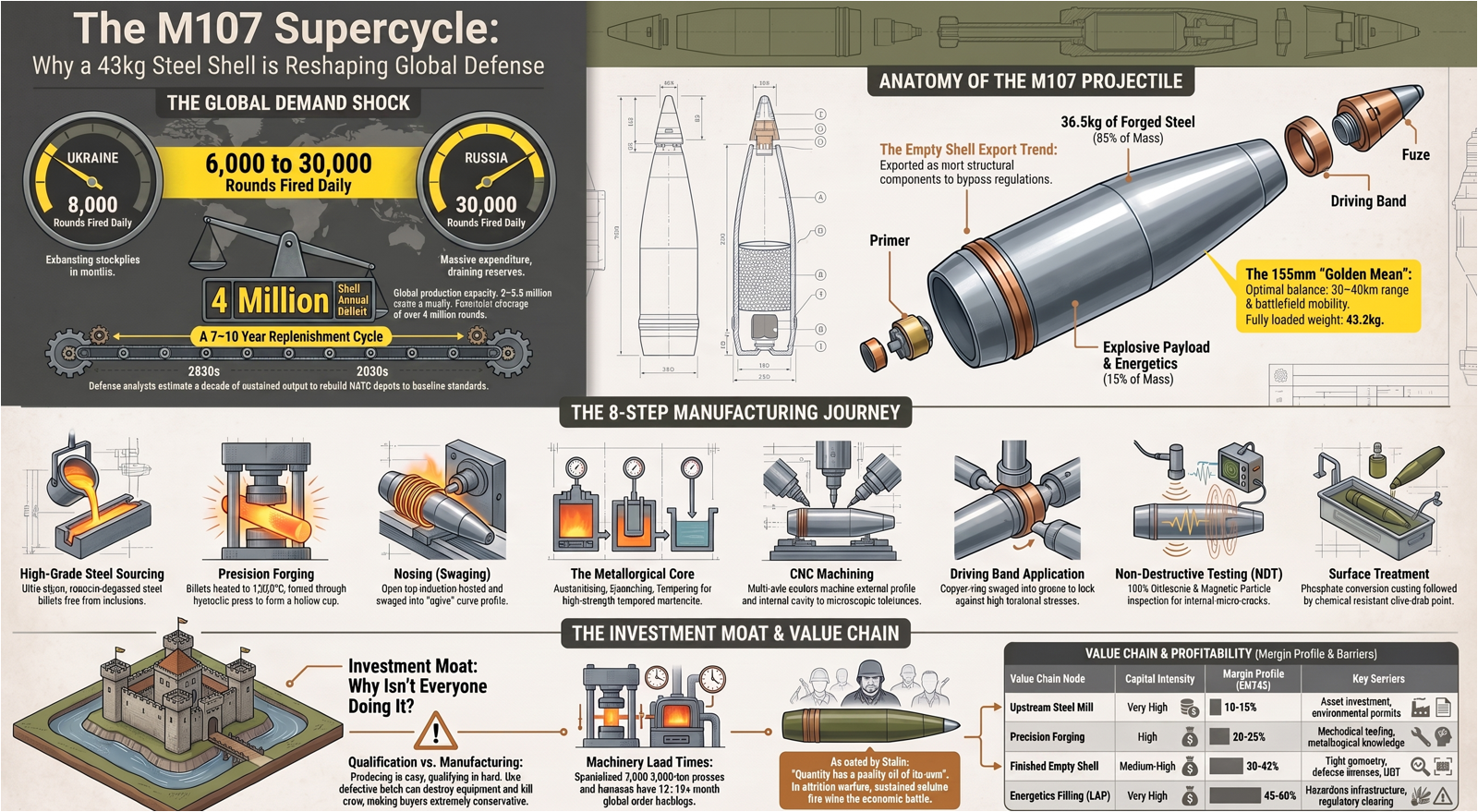
Ukraine alone has at times fired 6,000–8,000 artillery rounds every day, while Russian forces have reportedly fired 20,000–30,000 rounds daily during intense fighting. Stockpiles that were expected to last years disappeared within months, exposing a defense industrial base that simply could not replenish ammunition fast enough.
The consequences extend far beyond Europe.
NATO countries are rebuilding depleted inventories. Israel has accelerated domestic ammunition production after the 2026 conflict. Asian nations are expanding strategic reserves amid rising geopolitical tensions. India is replacing legacy artillery systems with modern 155mm platforms under its long-term modernization programme.
This has created one of the largest ammunition replenishment cycles since the Second World War.
At the centre of this rebuilding effort lies an unexpectedly simple product:
The 155mm M107 artillery shell.
Not the sophisticated electronics.
Not precision guidance systems.
Not even the explosives inside.
The opportunity begins with something far less glamorous, the empty steel shell body.
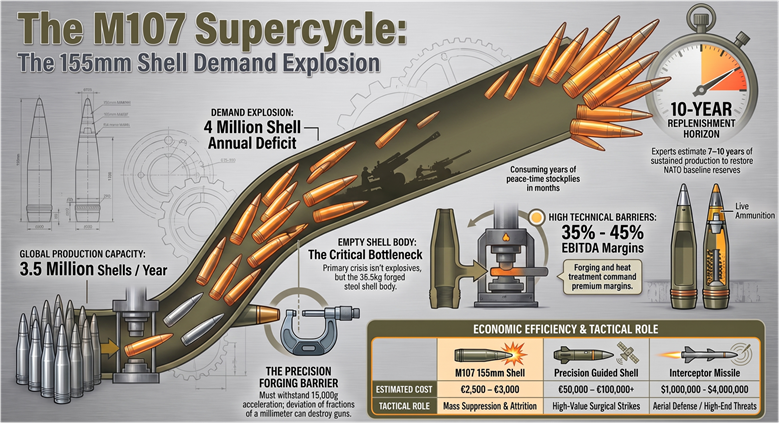
To most people it appears to be little more than a hollow piece of forged steel. In reality, it is one of the most demanding metallurgical products manufactured in the defense industry. Every shell must survive enormous firing pressures, withstand accelerations exceeding 15,000 g, maintain microscopic dimensional tolerances and fragment in a predictable manner after detonation. A deviation of even fractions of a milli-metre can dramatically alter ballistic performance or, in the worst case, destroy the artillery gun itself.
More importantly, the world does not have enough of them.
Global manufacturing capacity remains well below demand despite billions of dollars of announced investments. New forging facilities require specialized hydraulic presses, sophisticated heat-treatment systems, precision machining centres and military certifications that often take years to obtain. Building capacity is far easier on paper than in reality.
This imbalance has transformed what was once considered a low-profile industrial component into one of the fastest-growing segments of the global defence manufacturing ecosystem.
Indian companies have recognised this shift earlier than many expected.
Over the past two years, numerous listed manufacturers, ranging from established defence leaders to relatively unknown forging companies, have announced capacity expansions, export contracts and new investments aimed specifically at the global shortage of 155mm artillery shells. For many of these businesses, defence is no longer a peripheral activity but an emerging growth engine capable of transforming their long-term earnings profile.
This article explores the ecosystem behind the M107 shell from metallurgy and manufacturing to geopolitics, economics and listed investment opportunities.
Because sometimes the biggest investment themes don’t begin with revolutionary technology.
Sometimes they begin with a 43-kilogram piece of forged steel.
Before we proceed further, here is a brief of what we will be reading in this:-
The Tiny Steel Shell Rebuilding the World’s Armies (Introduction- read already )
Meet the M107: The World’s Most Widely Used Artillery Shell
3. Demystifying “155mm” and “M107”.
Why 155mm Became the Global Standard
Show Me the Demand
The Real Bottleneck Isn’t Explosives
Why Countries Prefer Buying Empty Shells
From Steel Billets to Battlefields: How an M107 Shell Is Made
The M107 Value Chain: Who Makes What?
If It’s So Profitable, Why Isn’t Everyone Doing It?
The Economics
India’s Defence Manufacturing Renaissance
How India Exports Military Hardware
The Investment Opportunity: Who Could Benefit?
What Could Go Wrong?
Final Thoughts: The Tiny Shell Behind a Multi-Billion Dollar Opportunity
So lets continue:-
2. Meet the M107: The World’s Most Widely Used Artillery Shell
Before discussing the investment opportunity, it is important to understand what exactly is being manufactured.
Many of us assume that a 155mm artillery shell is a single product. In reality, it is a complete weapons system made up of several specialized components manufactured by different companies across the defense supply chain. Think of it like a car. Very few companies manufacture the entire automobile. One company builds the engine. Another makes the tyres. Someone else makes the airbags. Artillery ammunition works surprisingly similarly.
The companies making headlines today are, in most cases, not manufacturing complete ammunition. They are producing one of its most critical components - the empty shell body.
That distinction is important because it determines the technology required, the capital invested, the regulatory approvals needed, and ultimately the economics of the business.
What is an M107 Shell?
The M107 is the world’s most widely used 155mm High Explosive (HE) artillery projectile. Originally developed for the U.S. Army during the Cold War, it eventually became the standard heavy artillery round across NATO and many allied nations. Even after several decades and the introduction of newer ammunition designs, the M107 remains one of the most extensively produced artillery shells in the world due to its vast stockpiles.
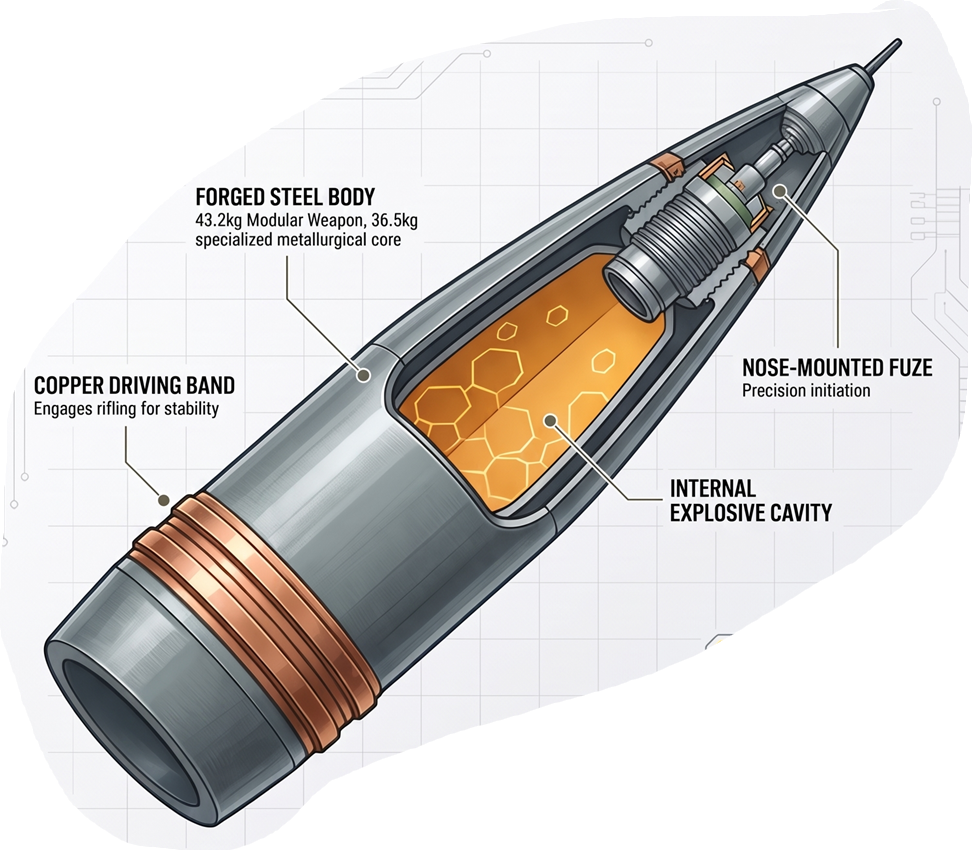
A fully assembled M107 projectile weighs approximately 43.2 kilograms, of which nearly 36.5 kilograms is the forged steel shell body itself. The remaining weight consists primarily of explosive filling, fuze assembly and associated components.
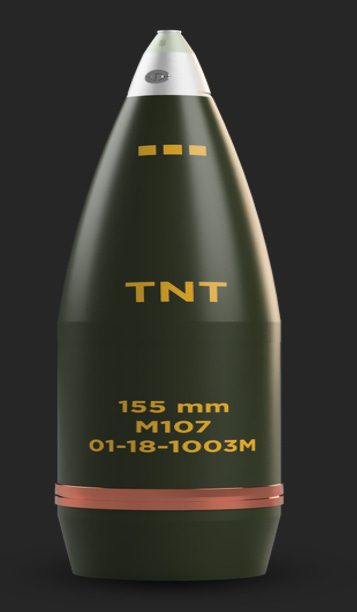
The shell is fired from 155mm howitzers (such as the M109 self-propelled howitzer or the M777 towed howitzer). More than 75 armies across the world use 155 mm-compatible systems, including the US Army’s M777, India’s Dhanush and K9 Vajra-T, and nearly every NATO country, and it has become the global standard for long-range land warfare.
Why It Matters
In modern conventional attrition warfare, artillery remains the “King of Battle.” It holds this title because it reliably delivers the heaviest, most destructive, and most cost-effective firepower over long distances to shape the battlefield for ground troops. The shell body is not merely a container; it is a highly regulated, precise ballistic tool. If the metallurgy is uneven, the shell can suffer a catastrophic premature detonation inside the gun barrel, destroying a million-dollar howitzer system and killing the crew. Conversely, if manufacturing tolerances deviate by fractions of a millimeter, the aerodynamic drag and mass distribution shift, causing the shell to miss its target by hundreds of meters.
Do watch this for the ground report
3. Demystifying “155mm” and “M107”
What is 155mm? (The Calibre)
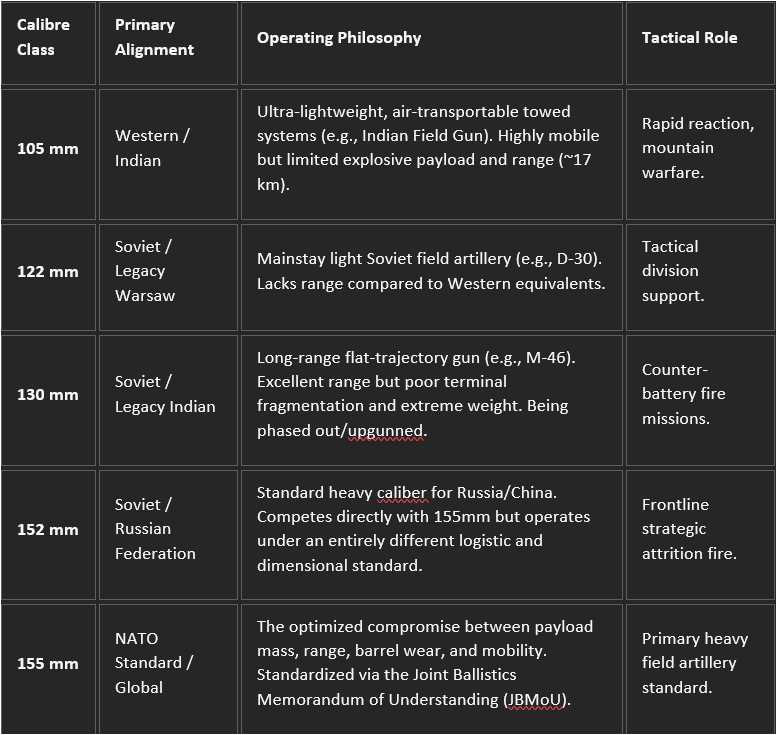
Artillery guns are categorized by the internal diameter of their barrel, known as the calibre. A 155mm artillery system has a barrel with a bore diameter of exactly 155 millimeters (about 6.1 inches). Globally, 155mm has become the standard “heavy field artillery” standard for NATO and allied nations because it strikes the perfect mathematical balance: it is large enough to carry a devastating explosive payload over long distances ( 30km to 40km ), yet light enough that the military hardware remains mobile on the battlefield. A larger shell carries more explosives but is heavier, reducing mobility and increasing logistical costs. A smaller shell is easier to transport but delivers less destructive power. After decades of battlefield experience, most Western militaries converged on 155mm as the optimal balance.
Interestingly, India is also following the same path.
For decades, the Indian Army operated a mix of 105mm, 122mm, 130mm and 155mm artillery systems, inherited from different suppliers and different eras. While this offered flexibility, it also created a logistical nightmare. Different guns required different ammunition, spare parts, maintenance procedures and training. To eliminate this complexity, the Indian Army launched the Field Artillery Rationalisation Plan (FARP), under which legacy calibres are gradually being replaced by modern 155mm/52-calibre artillery systems. Platforms such as ATAGS , Dhanush , K9 Vajra-T ,Sharang upgrades are all part of this long-term transition. This means India’s requirement is not simply to procure new artillery guns. Each newly inducted gun requires thousands of compatible shells throughout its operational life for training, stockpiling and combat readiness. In other words, every new 155mm gun creates recurring ammunition demand for decades.
What is an M107? (The Target Product)
The M107 is the classic, universally adopted blueprint for a 155mm High-Explosive (HE) fragmentation projectile. M107 is a specific projectile design blueprint. It dictates the exact weight (43.2 kg loaded), metallurgy, streamlined body curves (ogive profile), internal explosive cavity dimensions, and wall thickness. hen you see news footage of artillery pieces firing, they are most frequently loading an M107-profile shell.
A complete, live M107 shell consists of three primary layers:
The Energetics (Live Explosives & Propellant Modules): The chemical payload filled inside.
The Fuze: The electronic or mechanical nose cone that dictates when the shell explodes (e.g., upon hitting the dirt or right above the target).
The Empty Shell Body: This is the hollow metal cylinder shaped like a massive pen tip. It weighs roughly 36.5 kg empty and is made of specialized High-Fragmentation (HF) steel.
4. Why 155mm Became the Global Standard
M107 vs M795: Why the Older Shell Refuses to Disappear
A natural question is: If the M107 was designed decades ago, why hasn’t it been replaced?
Technically, it has. The M795 is the newer U.S. standard artillery shell.
It offers several improvements over the M107, including around 30% greater lethality , better fragmentation , Longer range, Improved metallurgy and Greater effectiveness against light armored vehicles . Yet despite these advantages, the M107 continues to dominate production in many parts of the world. The reason is surprisingly simple.
“Quantity has a quality all of its own.”- Soviet leader Joseph Stalin
When Nazi Germany invaded the USSR in 1941, the Soviet Union initially suffered catastrophic losses. Germany generally had Better-trained troops, Superior tactics , More experienced officers and Better tanks and aircraft in many engagements.
However, the Soviet Union possessed something Germany couldn’t match: An enormous industrial base capable of producing weapons in staggering quantities.
Instead of trying to build the “best” tank or artillery piece, Soviet factories focused on producing good enough equipment in huge numbers.
Economics.
Modern precision artillery is extraordinarily expensive. Depending on the configuration, advanced shells can cost anywhere from €5,000 to well over €100,000 each. By comparison, a conventional M107 costs only around €2,500–3,000. Military planners therefore reserve precision-guided ammunition for high-value targets. For suppressing infantry, neutralizing defensive positions, clearing minefields or supporting large-scale offensive operations, quantity often matters more than perfect accuracy.
As the Ukraine war has repeatedly demonstrated, the side capable of sustaining the highest volume of artillery fire frequently enjoys the operational advantage. The M107 may no longer be the most advanced artillery shell in the world. But in an era where nations are rebuilding millions of rounds of ammunition, it remains one of the most relevant.
So, M107 was the past, the present and the future.
Reason is- ultimately, it’s a money game.
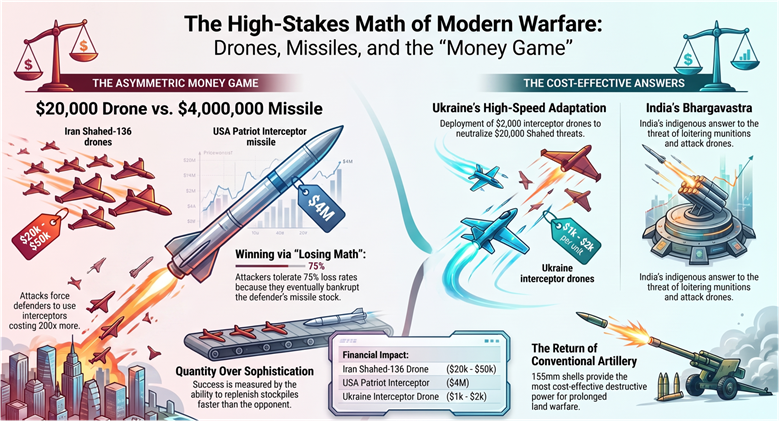
To understand this, let’s discuss the recent Iran-USA-Israel war. It became ongoing again last night. We all know, what Iran did till now. Iran has successfully utilized asymmetric warfare by deploying inexpensive one-way attack drones (such as the Shahed-136, costing roughly $20,000 to $50,000). Iran built this simple drone, the Shahed, with a motorcycle-type engine, loaded it with explosives and successfully targeted its neighbors’ cities and power plants. Iran has also hit U.S. military bases with these drones, including an early April 2026 attack on the U.S. Victory Base Complex in Baghdad. It forced the U.S. and its allies to expend million-dollar interceptor missiles (such as the Patriot system, which costs up to $4 million per shot). The U.S. military has a $1 million answer to a $20,000 question. This math tells you almost everything you need to know about one of America’s biggest national security headaches. And the interesting part is that the U.S. military watched this happen in Ukraine for years. It knew the threat was coming. The Shahed isn’t impressive because it’s high-tech. It’s impressive because it isn’t. Inspection of captured Shahed drones has found that many of their parts are made by ordinary commercial companies.
That includes processors from a U.S. manufacturer, fuel pumps from a U.K. company and converters from China. Russia, which also produces the drone, tolerates losing more than 75% of its Shahed stock because even at those loss rates, it’s winning the math battle against Ukraine. Russia or Iran don’t need every drone to hit its target. They just need to keep sending waves of them until their opponent runs out of expensive missiles to shoot back.
Just for curiosity in what happened after this- Ukraine, which had no choice but to learn fast, eventually figured out a better answer. Ukraine developed cheap interceptor drones that could slam into Shahed drones before they reached their targets. Each interceptor costs about $1,000 to $2,000, and Ukrainian manufacturers are producing thousands of them per month. That’s better math: a $2,000 interceptor against a $20,000 attacker.
Coming to India, Bhargavastra is India’s indigenous answer to the threat of loitering munitions and attack drones like the Iranian-designed Shahed.
So, defence procurement eventually becomes an economics exam. The side that goes bankrupt first usually doesn’t win.
Other calibres
The Indian Army’s artillery fleet is undergoing its largest structural transition since independence under the Field Artillery Rationalization Plan (FARP). The primary objective is to phase out legacy Soviet and indigenous calibres (105mm, 122mm, and 130mm) and standardize the entire artillery inventory onto a uniform 155mm / 52-calibre baseline.
5. Show Me the Demand
Why the World Suddenly Needs Millions of 155mm Shells
The answer to ‘Show me the growth’ comes after you show me the demand.
For nearly three decades after the Cold War, the defense priorities of most developed nations underwent a dramatic shift.
Military planners increasingly assumed that future wars would be short, technology-driven conflicts dominated by precision-guided missiles, stealth aircraft, drones and cyber warfare. Conventional artillery ammunition, once considered the backbone of land warfare, gradually became an afterthought. Governments reduced production capacity, consolidated ammunition factories and relied on stockpiles accumulated over decades.
That assumption proved to be one of the biggest strategic miscalculations of modern military history.
The Russia-Ukraine war demonstrated that despite rapid advances in military technology, wars are still won by industrial capacity. Instead of a quick campaign dominated by precision weapons, the conflict evolved into a prolonged war of attrition where artillery once again became the primary instrument of battlefield destruction. Ukraine has at times fired 6,000–8,000 artillery rounds every day, while Russian forces have reportedly fired 20,000–30,000 rounds daily during periods of intense fighting.
The Ukraine conflict also exposed another weakness.
For years, defense manufacturing had quietly adopted many principles from commercial industry.
Lean inventories. Minimal stockpiles. Optimized supply chains. Just-in-time manufacturing.
Toyota made “Just-in-Time” manufacturing famous. It revolutionized civilian manufacturing. Unfortunately, wars rarely send calendar invitations.
Those approaches work remarkably well in civilian industries. They fail spectacularly during prolonged wars.
Once ammunition consumption accelerated, governments discovered that rebuilding production capacity was far slower than consuming ammunition.
Heavy forging presses cannot be ordered overnight. Heat-treatment furnaces cannot be installed in a few weeks. Military qualification takes years.
The result was a classic supply shock.
Demand exploded almost immediately. Supply could expand only gradually.
Stockpiles that were expected to last years disappeared within months, exposing a defense industrial base that simply could not replenish ammunition fast enough.
Initially, NATO countries focused on supplying ammunition to Ukraine from existing inventories. That solution worked only temporarily. Every shipment sent to Ukraine reduced their own strategic reserves.
Eventually, the challenge shifted from supporting Ukraine to rebuilding national stockpiles.
The customer was no longer just Ukraine.
The customers became The United States , Germany, France, Poland, United Kingdom ,Italy ,Canada , Australia and other NATO allies
Each country now faces the same problem:
How do we rebuild ammunition inventories that took decades to accumulate?
This is why many industry observers believe the current demand cycle is not measured in quarters but in years.
Today, global production capacity is estimated at only 3–3.5 million shells annually, leaving a structural supply deficit of more than 4 million shells every year.
The important point, however, is that the investment thesis does not depend solely on ongoing wars. Even if geopolitical tensions moderate, governments cannot simply return to pre-2022 inventory levels. Ammunition warehouses have to be rebuilt, strategic reserves replenished and training inventories restored. Most defense analysts estimate that returning to comfortable stockpile levels will require at least 6-7 years of elevated production, even under optimistic geopolitical scenarios. In other words, today’s demand is not merely wartime consumption; it is the beginning of a multi-year global replenishment cycle.
And this is where the investment story begins.
When demand rises this sharply, investors naturally ask the next question:
Who will manufacture all these shells?
The answer depends not on who can assemble complete ammunition, but on who possesses the specialized forging, heat treatment, precision machining and quality-control capabilities required to manufacture the empty shell body- the single largest and most technically demanding component of the entire projectile.
Why Empty Shell Bodies Are Becoming a Strategic Export
One question naturally follows from the demand story.
If countries urgently need millions of artillery shells, why aren’t they simply manufacturing them domestically?
After all, an empty shell body is just a hollow steel casing.
Or is it?
The answer reveals one of the least understood aspects of the global defense industry.
The current shortage of 155mm ammunition is not caused by a lack of steel. Nor is it solely due to a shortage of explosives. Instead, it is the result of multiple bottlenecks across the ammunition value chain, each requiring different capabilities, infrastructure and regulatory approvals.
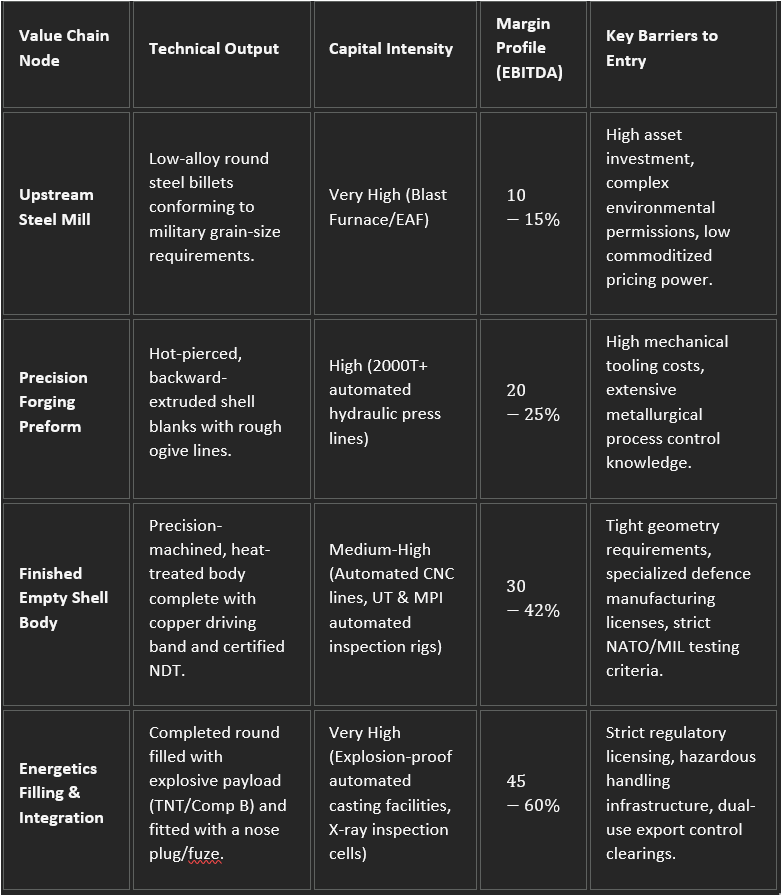
The manufacture of a complete artillery shell can broadly be divided into four stages:
Production of high-grade steel billets.
Forging and machining of the empty shell body.
Loading the shell with explosives.
Final assembly, fuse integration and packaging.
While these steps eventually produce a single round of ammunition, they are often carried out by entirely different companies and frequently in different countries.
This separation of responsibilities has become even more pronounced over the past few years.
6. The Real Bottleneck Isn’t Explosives
The Global Bottleneck Isn’t Where Most People Think
When discussions began around shortages of artillery ammunition after the Russia-Ukraine war, many assumed the limiting factor would be explosives.
Ironically, one of the biggest bottlenecks turned out to be the empty shell body that doesn’t explode.
Manufacturing an M107 shell body is a capital-intensive metallurgical process requiring specialized forging presses, precision machining centers, automated heat-treatment lines and rigorous quality assurance systems. Building such facilities requires years of investment, highly skilled manpower and extensive military qualification.
Explosive filling, on the other hand, is a completely different business.
Many Western defense companies already possess sophisticated Loading, Assembling and Packing (LAP) facilities capable of filling shells with their preferred explosive formulations. What they increasingly lack is sufficient upstream forging capacity to supply empty shell bodies at the volumes now required.
As a result, the global supply chain has evolved into a more specialized model.
Countries import precision-manufactured empty shell bodies from trusted suppliers and complete the final integration domestically.
7. Why Countries Prefer Buying Empty Shells
At first glance, exporting an unfinished product instead of complete ammunition appears inefficient.
In reality, it offers several important advantages.
In the defense value chain, the process of filling an empty shell body with high explosives is known as L.A.P. (Loading, Assembling, and Packing). Because handling military-grade energetics requires hazardous-duty infrastructure and severe safety clearances, only a few specialized entities perform this inside India:
Public Sector Dominance (State PSUs)- Munitions India Limited (MIL): Specifically its frontline production assets like High Explosive Factory (HEF) Khadki, Ordnance Factory Itarsi, and Ordnance Factory Chanda. MIL is the historical monopoly holder for mass-scale melt-casting of TNT, Composition B, and modern Insensitive Munitions (IM) mixtures into large-caliber artillery shells for the Indian Armed Forces.
Private Sector Aggregators
i) Solar Industries India Limited: The clear private-sector leader. Solar possesses advanced, automated, explosion-proof integration lines capable of handling sophisticated military energetics. It is the first private company in India to fully integrate complete 155mm artillery rounds (including weapon payloads, propellants, and bi-modular charge integration) for international export clients and domestic military trials.
ii) Premier Explosives Limited: Primarily specialized in solid propellants, pyrotechnics, and missile motor grains, they provide inner-tier energetic materials and components that feed into the large-caliber ammunition ecosystem.
Now, an Empty Shell is Exported or Fully Integrated. Both models are actively utilized, but the global defense market is currently seeing an unprecedented surge in the export of empty shell bodies alone.
When an Indian manufacturer signs an export contract, they are frequently shipping unfilled, precision-machined, heat-treated steel bodies (complete with copper driving bands and nose-thread protectors) rather than live ammunition due to following reasons:-
A. The Global Energetics & Propellant Bottleneck
The current worldwide shortage of 155mm ammunition isn’t just about forging steel; it is heavily constrained by a lack of chemical raw materials (like nitrocellulose, specialized acids, and TNT flakes) and a shortage of automated melt-cast loading facilities in the West.
International defense primes (such as Rheinmetall in Germany, Nammo in Norway, or General Dynamics in the US) often have their own local filling factories but lack the heavy forging capacity to manufacture the steel bodies fast enough. They import the empty shell bodies from India to feed their existing local loading lines, resolving their hardware bottlenecks.
B. Interoperability and Proprietary Explosive/Fuze Standards
Western nations frequently require very specific explosive compositions or advanced fuzes that comply with their localized safety standards. By importing a highly standardized, precise empty shell body (like the M107 profile), a Western defense contractor can fill it with its own proprietary explosive mixtures and fit it with its own digital fuzes (like the precision-guided M982 Excalibur electronics or standard NATO proximity fuzes).
C. Regulatory and Geopolitical De-risking
Exporting live, explosive military ordnance requires navigating intense international regulatory hurdles, transit permissions through third-party ports, and strict sovereign dual-use clearings. Shipping a precision-machined piece of high-fragmentation steel (the empty shell body) carries a lower regulatory risk profile. It is classified under structural components, making transport logistics, shipping insurance, and export clearance protocols much easier to execute.
D. Transit and Storage Safety
Unfilled steel shells are completely inert. They can be stacked, handled, and shipped via commercial maritime container lines without requiring hazardous material isolation vessels, high-security specialized shipping fleets, or explosion-risk handling protocols at ports. This significantly reduces international transport costs.
8. From Steel Billets to Battlefields: How an M107 Shell Is Made
Step-by-Step Production Process
If you’ve ever watched the television show How It’s Made, imagine the industrial version with furnaces glowing at over 1,200°C, 2,000-ton hydraulic presses, robotic heat-treatment lines and quality inspections where microscopic defects can reject an entire shell.
The manufacturing flow of a 155mm shell body requires a complex combination of heavy industrial scale and high-precision tolerances.
If you are like me and need to watch the process to better understand, here is the video of the process
If no or still want to read, give it a go.
1. Raw Material Sourcing
The process begins with ultra-clean, vacuum-degassed round steel billets (typically 180–200mm in diameter) sourced from high-grade specialty mills (e.g., Steel Authority of India). Billets must be entirely free from macro-segregation, pipe defects, or non-metallic inclusions.
2. Forging Operations
i) Heating: Billets are sliced into distinct individual lengths (”slugs”) and heated to 1,150°C–1,220°C in an automated rotary hearth furnace.
ii) Piercing (Upsetting): The hot slug is transferred to a vertical hydraulic press (typically 1,500–2,500 ton capacity), where a piercing mandrel forces its way down the center, initiating a backward extrusion process to form a thick, hollow, closed-end cup.
iii) Hot Drawing / Ironing: The hot cup is pushed through a sequence of reduction rings on a horizontal draw bench, refining the outer diameter wall thickness and elongating the body shell preform.
3. Nosing (Swaging)
The open top end of the elongated preform is locally induction-heated to ~950°C. A high-tonnage mechanical or hydraulic nosing press applies an axial die force, swaging the open cylinder into the characteristic ogive (tapered nose) curve profile of the M107.
4. Heat Treatment Line (The Metallurgical Core)
The structural integrity of the shell body is established during this phase:
i) Austenitizing: The shell bodies enter a continuous walking-beam furnace, heated to 840°C–870°C and held until the micro-crystalline structure becomes completely uniform austenite.
ii) Quenching: Automated robotic manipulators plunge the shells vertically into a highly agitated polymer-water or oil quench tank. Vertical immersion prevents asymmetric cooling, which would otherwise warp the body.
iii) Tempering: The shells are immediately transferred to a tempering furnace at 500°C–600°C to relieve internal stresses, transforming brittle martensite into tough, high-strength tempered martensite.
5. Precision Machining
i) Rough/Finish CNC Turning: Multi-axis heavy-duty CNC turning centers machine the external profile, establishing strict wall thickness concentricity.
ii) Deep Hole Boring: Specialized internal boring heads machine the internal explosive cavity to an absolute smooth finish, minimizing weight variance across production runs.
iii) Thread Cutting: Precision milling heads tap the nose thread profile to receive the standard fuze adapter.
iv) Driving Band Groove Machining: A undercut groove featuring longitudinal knurling or “waving” is machined near the base to lock the copper driving band in place against high torsional stresses.
6. Driving Band Application
A pre-formed seamless pure copper or gilding metal (90% Cu, 10% Zn) ring is positioned over the machined groove. A multi-jaw radial hydraulic swaging press compresses the ring into the groove with immense pressure, forcing the copper to cold-flow into the locking features of the shell body. The copper band is then finish-machined to its final geometric profile.
7. Non-Destructive Testing (NDT) & Quality Control
i) Ultrasonic Testing (UT): Automated multi-probe UT rigs scan 100% of the shell walls to check for internal micro-cracks, gas porosity, or subsurface laminations.
ii) Magnetic Particle Inspection (MPI): The outer surface, particularly the high-stress nose and base radius regions, undergoes MPI to detect any microscopic surface imperfections.
iii) Hydrostatic Pressure Testing: Shell bodies are clamped into an isolation cell and pressurized internally with fluid up to 60–80 MPa to verify mechanical seam integrity.
iv) Weight Correction: Every single shell body is weighed; final weight tolerances are kept within +- 0.5% of nominal values, sorted into distinct weight zones matching army firing tables.
8. Surface Treatment, Preservation & Military Standards
The shells undergo hot alkaline cleaning, water rinsing, and an automated acid pickling stage before receiving a protective manganese-iron phosphate conversion coating. This coating provides a porous base layer that holds the final exterior finish: chemical-agent resistant, non-reflective olive-drab polyurethane paint, stamped with precise lot tracking numbers using high-contrast yellow stenciling.
9. The M107 Value Chain: Who Makes What
10. If It’s So Profitable, Why Isn’t Everyone Doing It
Looking at today’s demand-supply imbalance, we may assume that manufacturing empty artillery shells is simply a matter of investing in a few forging presses and CNC machines.
If demand is expected to remain strong for years, why wouldn’t dozens of engineering companies enter the business?
The answer lies in the difference between manufacturing and qualifying.
In defense, producing a component is only half the battle. Convincing a military customer that every single unit will perform identically under battlefield conditions is considerably harder. That distinction creates one of the industry’s strongest competitive moats.
Defense Isn’t a Typical Manufacturing Business
In most industrial sectors, a new manufacturer can purchase machinery, hire engineers and begin supplying customers within months. Defense manufacturing works differently.
Before a shell body can enter serial production, it must undergo an exhaustive qualification process involving metallurgical validation, dimensional inspections, proof firing, fragmentation analysis, environmental testing and repeated consistency checks.
Unlike commercial products, there is almost no tolerance for failure. One defective automotive component may lead to a warranty claim. One defective artillery shell can destroy a multi-million-dollar howitzer and kill its crew. As a result, military procurement agencies are naturally conservative. Winning approval often takes far longer than building the factory itself.
The Machines Themselves Are a Barrier
Heavy forging equipment isn’t something that can be ordered off the shelf. Modern shell production requires hydraulic presses ranging from roughly 2,500 to 5,000 tonnes, specialized rotary furnaces, automated heat-treatment lines, deep-hole boring machines, heavy-duty CNC machining centers and sophisticated non-destructive testing systems. Many of these machines have global delivery timelines stretching well beyond a year, particularly as defense manufacturers around the world simultaneously expand capacity. Even after installation, process optimization takes time. Heat-treatment recipes must be perfected. Machining tolerances refined. Inspection systems calibrated. Only then can formal qualification begin.
In other words, capital expenditure marks the beginning of the journey, not the end.
Experience Cannot Be Purchased
Perhaps the biggest misconception is that shell manufacturing is simply another forging business. It isn’t.
Much of the competitive advantage resides not in machinery but in accumulated manufacturing knowledge. How long should the billet remain inside the furnace? How rapidly should it be quenched? How does steel from one supplier behave differently from another? How should machining parameters change as cutting tools wear? How can dimensional consistency be maintained across hundreds of thousands of units?
These are questions answered not by textbooks but through years of production experience. Warren Buffett often says:
“It takes 20 years to build a reputation and five minutes to ruin it.”
Defense manufacturing operates under exactly the same philosophy. One failed batch can destroy years of credibility.
This explains why several newer entrants have recruited veterans from India’s former Ordnance Factory Board or acquired businesses possessing decades of defense manufacturing expertise rather than attempting to develop everything internally. In defense manufacturing, know-how often compounds just like capital.
Exporting Defense Products Adds Another Layer of Complexity
Manufacturing an empty shell body is only part of the challenge. Selling it internationally introduces another. Every export requires multiple layers of regulatory approval designed to ensure that military equipment reaches only authorized governments.
The Industry Is Still Capacity Constrained
Despite the growing number of announcements over the past two years, global supply remains well below projected demand. The reason is simple. Building capacity takes time. Military qualification takes longer. And customer trust takes the longest.
This means the current opportunity is unlikely to disappear simply because additional companies announce expansion plans. Execution-not announcements-will ultimately determine who benefits.
For us, that distinction is crucial.
A company announcing a new defense facility is very different from a company that has already:
a) qualified its products,
b) passed proof-firing tests,
c) secured export approvals,
d) and begun commercial deliveries.
The market often values both similarly during periods of optimism.
Over time, however, execution usually separates the winners from the aspirants.
11. The Economics
Economic Unit Cost Breakdown (Estimated Production Model)
Every investment eventually comes down to one question:
Can the company make money?
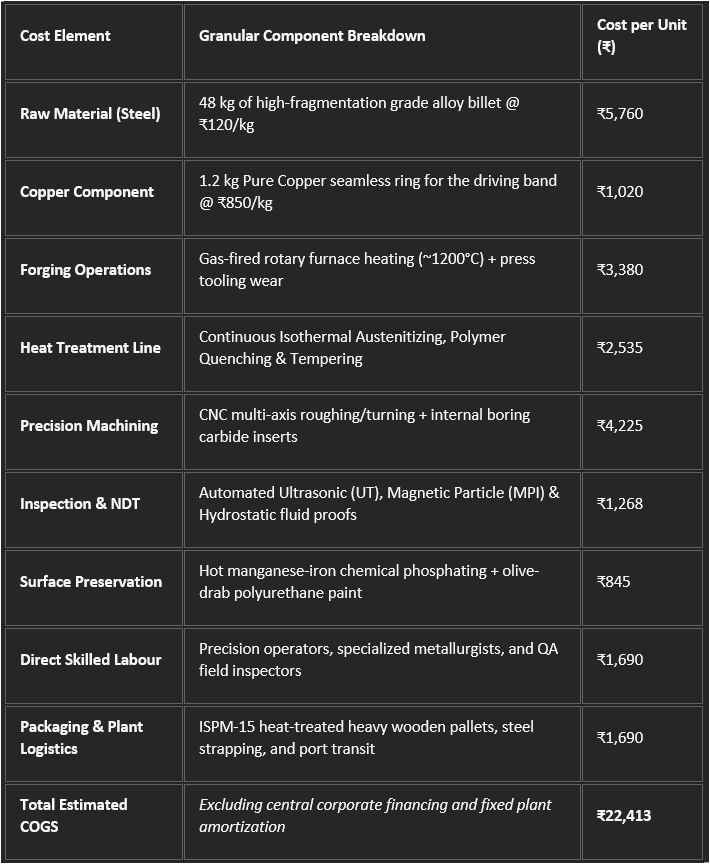
The following economic matrix models the estimated cost architecture of a single 155mm M107 empty shell body manufactured within a high-volume, automated Indian private sector forging and precision machining facility.
i) Assumed Nominal Production Scale: 100,000 units per annum.
ii) Assumed Billet Sizing: ~48 kg of Premium Vacuum-Degassed Carbon-Manganese Steel Round Billet per shell body (accounting for crop loss and machining chips).
Macro Price Realization and Margin Metrics
i) Estimated Blended Domestic Selling Price (Ex-Factory): ₹38,000 to ₹42,000 per empty shell body.
ii) Estimated International Selling Price (FOB Indian Port - Current Market): $550 to $700 per unit (reflecting premium global pricing driven by structural shortages).
iii) Gross Margin Profile: 55-62% (on international sales).
iv) Blended Corporate EBITDA Margin Pool: 35-45%.
v) Projected Post-Tax Return on Capital Employed (ROCE): 28-36% across fully automated greenfield operations within 24 months of optimization.
12. India’s Defense Manufacturing Renaissance
The Evolution from OFB Corporatization to Competitive Exporting
For decades, India’s large-caliber ammunition production was the exclusive domain of the state-run Ordnance Factory Board (OFB). These operations often faced issues with low manufacturing efficiency, high overhead costs, and quality control deviations. In October 2021, the central government structured a major defense policy shift by dismantling the OFB and reorganizing its 41 production factories into seven unlisted, corporatized Public Sector Undertakings (PSUs).
i) Munitions India Limited (MIL): This entity absorbed 12 ammunition and explosives factories, with specialized capability across the entire large-caliber munition spectrum, including the M107 and extended-range ERFB platforms.
ii) Yantra India Limited (YIL): This PSU assumed control over heavy specialized metal components, specialized structural forgings, and rocket launcher components, operating as a key upstream processing partner.
Policy Drivers: Aatmanirbhar Bharat and the DAP Framework
The Defense Acquisition Procedure (DAP) incorporates structural provisions that prioritize domestic indigenously designed, developed, and manufactured (IDDM) aerospace and defense hardware. By implementing rolling “Positive Indigenisation Lists” that ban the import of various ammunition variants, the Ministry of Defence established an insulated, multi-year domestic demand environment for qualified private sector players.
Production Capacity Architecture & Export Performance
As of mid-2026, combined state and private manufacturing capacity for 155mm empty shell bodies has scaled toward 400,000–500,000 units per annum, with active capex targets pointing toward 10,00,000 units by 2030. Backed by the Department of Defense Production’s streamlined export authorization protocols, Indian entities have rapidly expanded their international footprint. Munitions India Limited (MIL) alone holds an export order book exceeding Rs.6,000 Crore, with major shipments routed to strategic partners across the UAE, Vietnam, and several European destinations seeking non-aligned ammunition lines.
13. How India Exports Military Hardware
Export Market & Regulatory Frameworks
Target Importer Demographics
Global export corridors for 155mm shell bodies are centered on NATO member nations, Eastern European partners seeking rapid stockpile replenishment, and Middle Eastern and Indo-Pacific defense forces aiming to diversify their security supply chains away from over-extended Western prime contractors.
[Indian Export Authorization Flow] [Private Manufacturer / PSU (M107 Empty Shell)]
↓
[Secures Firm International Purchase Contract]
↓
[Obtains End-User Certificate (EUC) from Foreign MoD]
↓
[Application to DDP (Department of Defence Production)]
↓
[Inter-Ministerial Strategic Export Review Committee]
↓
[Issuance of Formal No-Objection Export License]
Critical Regulatory Prerequisites
i) End-User Certificates (EUC): Export operations require a formal, non-transferable End-User Certificate verified by the importing country’s Ministry of Defense. This document guarantees that the empty shells will not be diverted to unauthorized third-party combatants.
ii) Sovereign Clearances: All shipments are subject to strict export controls overseen by the Department of Defense Production (DDP) and the Ministry of External Affairs, ensuring compliance with international dual-use export control regimes.
14. The Investment Opportunity: Who Could Benefit
The Indian Opportunity: Who Is Building the Next Generation of Ammunition Capacity?
This is also where investing becomes difficult. Every company presentation claims enormous opportunity. Not every company converts opportunity into earnings.
Broadly, the Indian listed universe can be divided into two categories.
Category I – The Integrated Defense companies/ elder brothers
These companies already possess significant defense manufacturing capabilities and participate across multiple segments of the ammunition value chain. They enjoy established customer relationships, diversified defense revenues, stronger balance sheets and lower execution risk.
For them, artillery ammunition is one growth engine among several.
1. Solar Industries India Limited
i) Business Overview: The undisputed leader in domestic commercial explosives and advanced military energetics. Solar Industries is one of the largest domestic manufacturers of bulk and cartridge explosives, detonators, detonating cords and components which find applications in the mining, infrastructure and construction industries. Company manufactures high-energy explosives, delivery systems, ammunition filling and pyros fuses for the defense sector.
Mar cap 1,62,000 Cr at 97PE.
ii) Defense Capabilities & Artillery Exposure: Owns highly specialized, explosion-proof automated facilities capable of handling cast-curing operations for TNT, Composition B, and insensitive munitions (IM) payloads. It is a key integration partner for loading, assembling, and packing (LAP) 155mm shells.
iii) Order Book & Capex Runway: Defence revenue is almost doubled. Now share is 27% of revenue. Of INR 21,300 cr total order book, defense is ~INR 18,000 cr; non-defense ~INR 3,000 cr
iv) Q4 concall on 155 mm ammunition: currently supplying “raw material intermediates going into this product.” Coupling facility to enable full rounds expected to finish “in next couple of quarters”; then “another 3 to 4 months’ time, then we will start supplying the complete round of 155 mm.”
2. Bharat Forge Limited (Kalyani Group)
i) Business Overview: Global forging powerhouse that has successfully transitioned into a premier strategic defense developer. It produces complete field artillery guns alongside complex mechanical armor and high-caliber precision ammunition preforms.
Mar cap- 1,00,000 cr at 85PE
iii) Defense Capabilities & Artillery Exposure: Unrivaled capabilities in heavy metallurgical forgings. It manufactures the complete family of 155mm artillery gun platforms (ATAGS, MArG, Bharat-52) and operates continuous automated extrusion lines capable of forging and finish-machining over 100,000 empty shell bodies annually for export markets via its subsidiary, Kalyani Strategic Systems.
iv) Order Book & Capex Runway: 55-60% new business from defense. Standalone defense export and domestic backlog, heavily driven by multi-year field artillery platform contracts in the Middle East and Europe.
v) On 155mm capacity- not going to discuss that. Let’s just say that we have adequate capacity and we are producing a large number of them. Plans to go into explosives also.
3. Sigma Microsystems Limited (Sigma Advanced Systems)
i) Business Overview: High-performance embedded electronics and precision engineering firm that has recently integrated into critical mechanical sub-systems for defense and precision ammunition components.
Mar cap- 9347cr at 33PE
ii) Defense Capabilities & Artillery Exposure: Transitioned from a pure-play electronic fuze and embedded module supplier to a full-scale artillery shell component manufacturer.
iii) Recent Regulation 30 Filings (Last 6 Months): In June 2026, the company announced a landmark export contract valued at 208 Crore to manufacture and supply 40,000 units of 155mm M107 artillery shell bodies to a prominent defense customer in North America. The order has received formal clearance from the Department of Defense Production (DDP).
iv) Competitive Advantage (Moat): Strong engineering cross-disciplinary capabilities. Combines advanced metallurgical shell manufacturing with inner-tier embedded systems, providing a solid foundation for the future domestic integration of electronic Precision Guidance Kits (PGK).
v) 155mm shell shortage supports 6-7year replacement demand.
4. Premier Explosives India Limited
i) Business Overview: Specializes in the manufacture of solid propellants, detonators, explosives, and structural rocket motor casings for India’s missile programs. Plans to be acquired by Apollo micro systems.
Mar cap- 3700cr at 74PE
ii) Defense Capabilities & Artillery Exposure: Provides highly reliable chemical propellant ingredients, bi-modular charge system (BMCS) components, and specialty energetic raw inputs to state integrators like Munitions India Limited.
iii) Competitive Advantage (Moat): One of the few private entities qualified to manufacture solid propellants for defense applications, backed by over three decades of operating history with the DRDO.
Category II – Pure Manufacturing Specialists & Micro/ small caps- younger brothers
The second category consists of companies whose primary opportunity lies in manufacturing empty shell bodies. Unlike integrated defense companies, these businesses focus on the precision forging and machining segment of the value chain. Their investment thesis is more concentrated. If global shell demand remains elevated, they stand to benefit disproportionately. However, they also carry higher execution risk because their fortunes depend much more heavily on successfully scaling defense manufacturing.
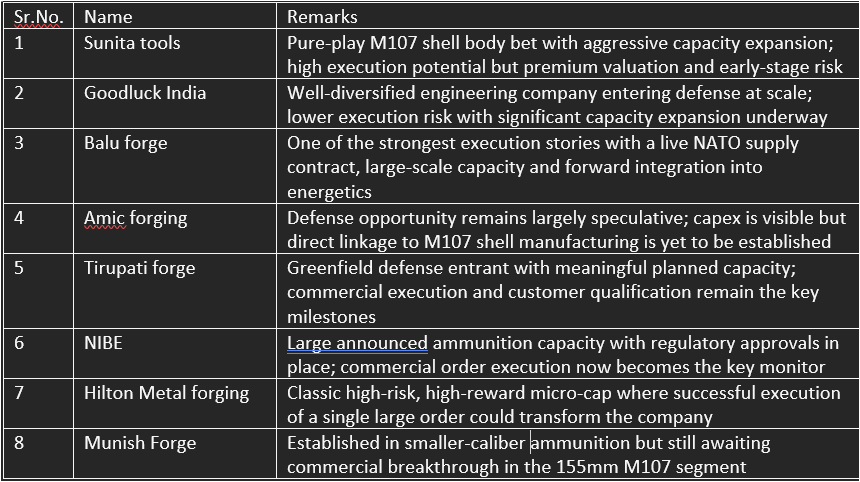
1. Sunita Tools-
Mar cap 500Cr at 78 PE, OPM from 28% to 15% in Q4FY26.
Originally a precision engineering company engaged in mould bases, steel plates, CNC machining and tooling for automotive, electronics and industrial applications. Listed on the SME platform in October 2023.
Entered the 155mm M107 artillery shell segment after identifying the global ammunition shortage, leveraging its expertise in steel cutting, machining, heat treatment and precision engineering.
Investing Rs.126 crore to expand annual shell manufacturing capacity to 3.6 lakh shells by March 2028.
Line 1 (Faridabad): Operational, capacity of 10,000 shells/month.
Line 2: Under execution, expected to commence from October 2026, adding another 20,000 shells/month, taking total capacity to 30,000 shells/month (3.6 lakh annually).
Existing facilities at Ahmedabad (engineering), Palghar (tools) and Faridabad (defence).
Acquired ready-to-use shell manufacturing machinery from T.S. Kisan & Co., an artillery shell manufacturer active between 1996 and 2006.
Strengthened execution capability by appointing Mr. Tarun Thapar, who has nearly three decades of shell manufacturing experience, as Executive Director (Technical).
Began defence capex in June 2025, completed successful machine trials in September 2025, and subsequently progressed towards commercial qualification.
Signed an interim agreement to supply 2.4 lakh NATO-standard 155mm M107 empty shell bodies over 24 months, with expected billing of approximately Rs.24 crore per month after commercial supplies commence.
Management claims to have received 100% advance payment from a NATO customer for prototype shells, with 33-34 quality processes already approved and only the final proof-firing test pending.
Management estimates the global shortage at around 4 crore shells annually, while India’s production capacity remains only 20-22 lakh shells, implying a large addressable opportunity.
Future strategy includes moving up the value chain into fully integrated explosive-filled shells, Precision Guidance Kits (PGK), Course Correcting Fuzes (CCF) and other smart ammunition technologies.
Incorporated Sunita Defense Inc. (Wyoming, USA) to bid for overseas defense contracts and pursue acquisitions in the aerospace & defense sector.
Also diversified into naval defense through acquisition of 51% stake in Avisan Global Tech & Avisan Engineering, providing access to shipbuilding, retrofit and naval weapon integration projects.
Promoter sold 3.1 lakh shares in November 2025, while the company simultaneously raised funds through preferential warrants to support expansion.
Mar cap 5110Cr at 28PE,
Integrated engineering company rapidly scaling defence forgings and artillery shell manufacturing
Diversified engineering company engaged in manufacturing steel structures, precision forgings, CR products, pipes, tubes, engineering structures and fabricated products, with an expanding presence in defence and aerospace.
Received an Industrial Licence under the Arms Act for manufacturing artillery ammunition across multiple calibres, including 105mm, 120mm, 125mm, 130mm and 155mm, covering HE M107, ERFB, ERFB-BB and ERFB-BT variants.
Defence manufacturing facility at Sikandrabad, Uttar Pradesh commenced commercial production in October 2025 with an initial installed capacity of 1.5 lakh artillery shells per annum.
The facility is already contributing to strategic defence programmes such as BrahMos and Pinaka, strengthening the company’s defence manufacturing credentials.
First commercial artillery shell order was completed and kept ready for dispatch, pending regulatory approvals and export clearances.
Defence business generated approximately Rs.46 crore revenue in FY26, with management expecting a sharp ramp-up as the plant reaches higher utilisation.
Management expects the existing facility to operate at 75-80% utilisation in FY27, implying annual defence revenue of approximately Rs.250-300 crore from the current capacity alone.
Approved a Rs.500 crore expansion programme to capitalize on strong global demand, funded through a 60:40 debt-equity mix (approximately Rs.400 crore debt/equity package).
Expansion will add another 2.5 lakh shells per annum, taking total installed capacity to around 4 lakh artillery shells annually, with commissioning targeted by late 2026 and meaningful revenue contribution expected from April 2027.
Management indicated having nearly eight months of confirmed orders and Letters of Intent (LOIs) covering almost two years, reflecting strong customer visibility.
Guided for approximately 1.35 lakh shell sales during FY27, implying a rapid utilisation ramp in the first full year of operations.
Management remains optimistic on long-term opportunities across both defence and aerospace, supported by sustained global demand for conventional ammunition.
Besides defence, the company continues to benefit from large infrastructure projects, including supplying steel products for the Mumbai-Ahmedabad Bullet Train project, while expecting additional opportunities as future high-speed rail corridors are announced.
Management expects around 20% growth in FY26, with stronger growth anticipated from FY27 onwards as defence capacity expansion begins contributing.
Management has highlighted that India’s annual requirement alone could eventually reach around 48 lakh 155mm artillery shells, providing a significant long-term domestic demand opportunity.
3. Balu forge-
Mar cap 5500Cr at 21PE
Large-scale forging player expanding into NATO-standard artillery shell manufacturing
Traditionally engaged in manufacturing fully finished and semi-finished forged crankshafts, precision forged components and engineering products catering to automotive, industrial and new energy vehicle applications.
Leveraging its core expertise in precision forging to diversify into defence manufacturing, with a focus on NATO-standard “Ready-to-Fill” artillery shell bodies.
Signed a 5-year supply agreement with a NATO-affiliated defence entity, marking one of the largest publicly disclosed contracts by an Indian private manufacturer in this segment.
The agreement provides for the monthly supply of 40,000 empty shell bodies, comprising 30,000 units of 155mm M107 shells and 10,000 units of 52mm ammunition.
Commercial deliveries under the contract commenced in April 2026, with the agreement containing provisions to scale supplies to over 1 lakh shells per month, subject to customer requirements.
Expanding its automated ammunition forging facility at its 46+ acre greenfield manufacturing campus in Belgaum, Karnataka.
Targeting installed production capacity of more than 3.6 lakh ammunition shell bodies annually, positioning itself among the larger private-sector shell manufacturers in India.
Entire expansion is being funded through internal accruals, avoiding equity dilution and significant debt while reflecting strong internal cash generation.
Pursuing forward integration through its newly incorporated subsidiary Quantum Energetics, with the objective of moving beyond forged shell bodies into higher value-added defence materials, energetics and ammunition-related products.
Holds NATO-standard manufacturing compliance certifications, enhancing its credibility with international defence customers and strengthening its export potential.
Unlike several newer entrants, Balu Forge combines an established large-scale forging base with ongoing defence expansion, potentially reducing execution risk while benefiting from the structural global shortage of artillery shell bodies.
4. Amic forging-
Mar cap 2000cr at 73PE
Precision forgings player with defence expansion potential
Manufacturer of steel forgings and precision-machined heavy engineering components catering to sectors such as oil & gas, power, railways, heavy engineering and industrial equipment.
Over the last few years, the company has undertaken an aggressive capacity expansion programme aimed at transforming itself into a larger integrated precision forging player, with defence emerging as one of its key focus areas.
Management has indicated that the company is approaching an inflection point, with its multi-year capital expenditure cycle transitioning from asset creation to commercial production and revenue generation.
Successfully completed Phase-I pre-commissioning of its integrated manufacturing expansion during May-June 2026, involving an investment of approximately Rs.150 crore.
The expanded facility is expected to significantly enhance forging, machining and integrated manufacturing capabilities, positioning the company to address opportunities in high-value engineering and defence applications.
At an Extraordinary General Meeting held in June 2026, shareholders approved a Rs.220.99 crore capital raise through preferential equity shares and convertible warrants to support future expansion and working capital requirements.
The fund raise witnessed participation from reputed institutional investors, including Motilal Oswal and noted investor Mukul Mahavir Agrawal, reflecting confidence in the company’s long-term growth plans.
While the company possesses manufacturing capabilities that could be relevant for defence forgings, management has not explicitly confirmed that the recently commissioned expansion or the capital raise is specifically linked to 155mm M107 artillery shell manufacturing.
Investors should therefore closely monitor future order announcements, defence customer additions and management commentary to assess whether the company meaningfully participates in the rapidly growing artillery shell opportunity.
5. Tirupati Forge Ltd/- ,
Mar cap 880cr at 141PE
New entrant building dedicated capacity for 155mm M107 shell bodies
Manufacturer of closed-die steel forgings and precision-machined components supplying industries such as automotive, agriculture, railways and industrial engineering, with defence identified as a major future growth vertical.
Entering the defence manufacturing space through a dedicated facility focused on producing 155mm M107 empty shell bodies, targeting opportunities arising from the global shortage of NATO-standard artillery ammunition.
The new defence manufacturing facility is in the final stages of commissioning, with inspections expected to conclude by the end of FY26 and trial production scheduled to be completed during Q4 FY26.
Commercial production is expected to commence shortly thereafter, making the company one of the latest listed entrants into India’s artillery shell manufacturing ecosystem.
Initial installed capacity is planned at approximately 1.2 lakh 155mm M107 empty shell bodies per annum, with management indicating a phased production ramp-up instead of immediate full-capacity utilisation.
The company expects to achieve full utilisation of the initial capacity by H1 FY27, subject to customer approvals, order inflows and successful commercial execution.
Management has already outlined plans for further capacity expansion from FY27 onwards, aiming to capitalize on sustained global defence spending and increasing international demand for artillery ammunition.
In July 2026, shareholders were convened for an Extraordinary General Meeting (EGM) to approve the issuance of 37 lakh convertible promoter warrants at Rs.58 per warrant, raising approximately Rs.21.46 crore.
The proposed fund raise has been earmarked for acquiring adjacent land, installing additional heavy machinery and strengthening working capital to support the scaling of the defence manufacturing business.
At peak utilisation, management estimates that the defence facility has the potential to generate annual revenue of up to Rs.250 crore, representing a significant opportunity relative to the company’s current size.
As commercial production is yet to begin, execution, customer qualification, proof-firing approvals and order conversion remain the key milestones for investors to monitor over the next 12–18 months.
6.NIBE-
Mar cap 2400cr at 420PE.
Integrated defence manufacturer building large-scale ammunition manufacturing capability
Incorporated in 2005, NIBE Ltd. operates across defence manufacturing, electric vehicle components and software development, with defence emerging as its primary growth driver.
The company has steadily expanded its defence portfolio from manufacturing critical defence components to establishing an integrated ammunition manufacturing ecosystem.
Inaugurated its Advanced Defence Manufacturing Complex at Shirdi, Maharashtra, representing one of the largest private-sector investments in India’s ammunition manufacturing infrastructure.
The facility houses an integrated artillery ammunition manufacturing pipeline with an installed capacity of approximately 5 lakh shells per annum, covering ammunition ranging from 40mm systems up to standard 155mm artillery shells.
The scale of the facility positions NIBE among the larger announced private-sector ammunition manufacturing capacities in India.
A major regulatory milestone was achieved on 6 June 2026, when its subsidiary NIBE Defence & Aerospace Ltd. received a Firearms and Ammunition Manufacturing Licence from the Department for Promotion of Industry and Internal Trade (DPIIT).
The licence authorises the industrial manufacturing and proof testing of high-calibre defence arms and ammunition, effectively removing the final major regulatory hurdle before commercial production.
With manufacturing infrastructure already established and regulatory approvals now in place, the company is positioned to commence commercial ammunition manufacturing, subject to customer qualification, proof-firing approvals and order execution.
Given the scale of its announced capacity, NIBE could emerge as a significant participant in India’s rapidly expanding ammunition manufacturing ecosystem if it successfully converts its manufacturing capability into commercial orders.
However, the company’s valuation remains among the highest in the sector, implying that investors are already discounting substantial future growth. Going forward, execution, order inflows and capacity utilisation will be the key factors determining whether operational performance keeps pace with market expectations.
7. Hilton Metal Forging Ltd/- When One Order Can Change the Company- Opportunity Versus Balance Sheet
Mar cap 117Cr at 34PE
Manufacturer of forged steel components catering to engineering and industrial applications, with recent diversification into defence through the manufacture of 155mm M107 empty artillery shell bodies.
Owing to its small size, Hilton represents one of the highest-risk, highest-reward opportunities in the listed defence manufacturing space, where successful execution of a single large contract can materially alter the company’s financial profile.
On 26 March 2026, the company announced a definitive agreement to supply 3.6 lakh NATO-standard 155mm M107 empty artillery shell bodies, valued at approximately Rs.720 crore, making it by far the largest order in the company’s history.
The contract provides for the supply of 15,000 shell bodies per month over a 24-month execution period, offering strong medium-term revenue visibility.
The agreement also incorporates a favourable payment structure, including advance payments equivalent to 50% of three months’ supplies, along with monthly invoicing before dispatch, significantly improving working capital visibility and reducing execution-related cash flow stress.
While the customer has not been disclosed, management has confirmed that the order has been received from a domestic entity.
To strengthen its balance sheet ahead of execution, the company completed a Rights Issue in April 2026, raising approximately Rs.27.97 crore through the allotment of 1.68 crore equity shares, increasing the paid-up capital from Rs.34.70 crore to Rs.51.47 crore.
Subsequently, in June 2026, the Board approved raising up to Rs.100 crore through a Qualified Institutional Placement (QIP), subject to shareholder approval, to fund future expansion and working capital requirements.
Promoter holding has seen significant changes over the past year, falling sharply from 27% in June 2025 to 7.87% in December 2025, before increasing to 18.56% in April 2026, making future promoter shareholding trends an important parameter to monitor.
Given its relatively small balance sheet, successful execution of the Rs.720 crore order could significantly transform the company’s scale, revenue and profitability. However, the investment case remains heavily dependent on execution, timely deliveries and the company’s ability to manage a contract that is several times larger than its historical business size.
8. Munish forge- Still Waiting for the Big Break
Mar cap 162Ct at 15 PE
Incorporated in 1986, Munish Forge manufactures forged and machined engineering components including flanges, scaffolding, auto parts, tank tracks, bomb shells, fence posts and other steel products, with defence emerging as a key growth vertical in recent years.
Raised approximately Rs.70 crore through its IPO and got listed in October 2025, providing capital to expand its manufacturing capabilities and defence business.
As per the H1 FY26 concall, the company had an order book of approximately Rs.113 crore, of which nearly Rs.70 crore related to defence. The execution timeline for the order book was estimated at 6–7 months.
Defence contributed around 10–12% of H1 FY26 revenue, with management expecting the contribution to increase as defence orders scale up.
The company has already received bulk production clearance for 120mm High Explosive (HE) bomb shells, marking an important milestone in its defence manufacturing journey.
The 105mm shell business is already commercial, with management stating that the company possesses the required approvals and is actively supplying these products.
For 155mm M107 shell bodies, the company has completed product development and submitted bids for two tenders floated by Ordnance Factory Kanpur. However, final approval remains contingent upon securing orders and completing customer qualification.
Management has also initiated discussions with major private defence companies, including Adani Defence, Tata and Reliance, besides engaging with ammunition filling plants to explore both domestic and export opportunities.
If commercial orders are received, management believes the company can initially manufacture around 5,000–6,000 units of 155mm shells per month, with scope for further expansion depending on demand.
While export opportunities are being explored, management has indicated that the immediate focus remains on the Indian defence market, citing significant domestic demand for artillery ammunition.
Management had guided for FY26 revenue of approximately Rs.205 crore and PAT margins of around 10%, driven by a defence-led second-half ramp-up. However, the company reported FY26 revenue of approximately Rs.183 crore with a PAT margin of around 6%, missing its stated guidance.
The company has not conducted any earnings conference call following the FY26 results, leaving investors awaiting greater clarity on the progress of its 155mm shell programme, defence order pipeline and future execution roadmap.
15. What Could Go Wrong
No investment theme is without risk.
Howard Marks often reminds investors:
“Being right isn’t enough. You also have to be right when everyone else is wrong.”
Defense may remain an attractive industry while individual stocks still disappoint if expectations become excessive.
Although the structural outlook appears favorable, we should also recognize several factors that could materially alter the industry’s trajectory.
Geopolitical De-escalation
The most obvious risk is a meaningful reduction in geopolitical tensions. A prolonged period of peace would reduce immediate wartime consumption. However, this risk should be viewed in context.
Even under a de-escalation scenario, replenishing depleted inventories is likely to remain a multi-year priority. Demand may moderate. It is unlikely to disappear.
Execution Risk
This is arguably the most important company-specific risk.
Building a defense factory is easier than operating one efficiently. Many recently announced facilities have yet to demonstrate Consistent production, Stable yields, Military qualification, Repeat export orders, Healthy capacity utilization.
We should therefore distinguish carefully between announced capacity and proven execution.
Commodity Inflation
Steel and copper constitute important raw materials in shell-body manufacturing. Sharp increases in input prices could pressure margins, particularly where contracts are fixed-price in nature. Companies possessing pricing flexibility or long-term customer relationships may be better positioned to absorb such volatility.
Policy and Export Restrictions
Defense exports remain closely regulated. Changes in export policy, geopolitical alignments or licensing requirements could delay shipments or restrict access to certain markets. Diversified customer bases can reduce this risk.
Valuation Risk
Perhaps the most overlooked risk is valuation itself. Many defense companies have experienced significant share price appreciation over the past two years. In several cases, investor expectations already discount years of future growth. A strong industry does not automatically guarantee strong investment returns if expectations become excessively optimistic.
As Benjamin Graham famously observed:
“Price is what you pay. Value is what you get.”
Even outstanding businesses can become poor investments when purchased at unrealistic valuations.
16. Final Thoughts: The Tiny Shell Behind a Multi-Billion Dollar Opportunity
The story of the M107 shell is, at first glance, a story about steel.
Look a little deeper, and it becomes a story about industrial capability.
Look deeper still, and it becomes a story about geopolitics, supply chains and the changing economics of modern warfare.
The world spent three decades optimizing defense industries for peace.
The events of the past few years have reminded governments that wars are not won by possessing the most sophisticated weapons alone.
They are won by the ability to manufacture enough of them.
That seemingly simple lesson has triggered one of the largest ammunition production cycles since the Cold War.
For Indian manufacturers, the timing could hardly be better.
The country possesses competitive manufacturing costs, strong metallurgical capabilities, supportive government policies and an expanding reputation as a reliable defense supplier. Companies across the spectrum from established leaders like Solar Industries and Bharat Forge to ambitious emerging players are positioning themselves to participate in this transformation.
Whether every company succeeds remains uncertain.
Execution will separate the winners from the hopeful entrants.
But the broader trend appears difficult to ignore.
As investors, we often search for disruptive technologies and revolutionary innovations.
Sometimes, however, extraordinary opportunities emerge from products that have existed for decades.
The M107 shell is one such example.
It is not new.
It is not glamorous.
It is simply indispensable.
And in investing, indispensable products operating within structural demand cycles often prove to be the most rewarding businesses of all.